


 Italiano


Cold pasta and rice salad: the unwritten etiquette of the Italian summer
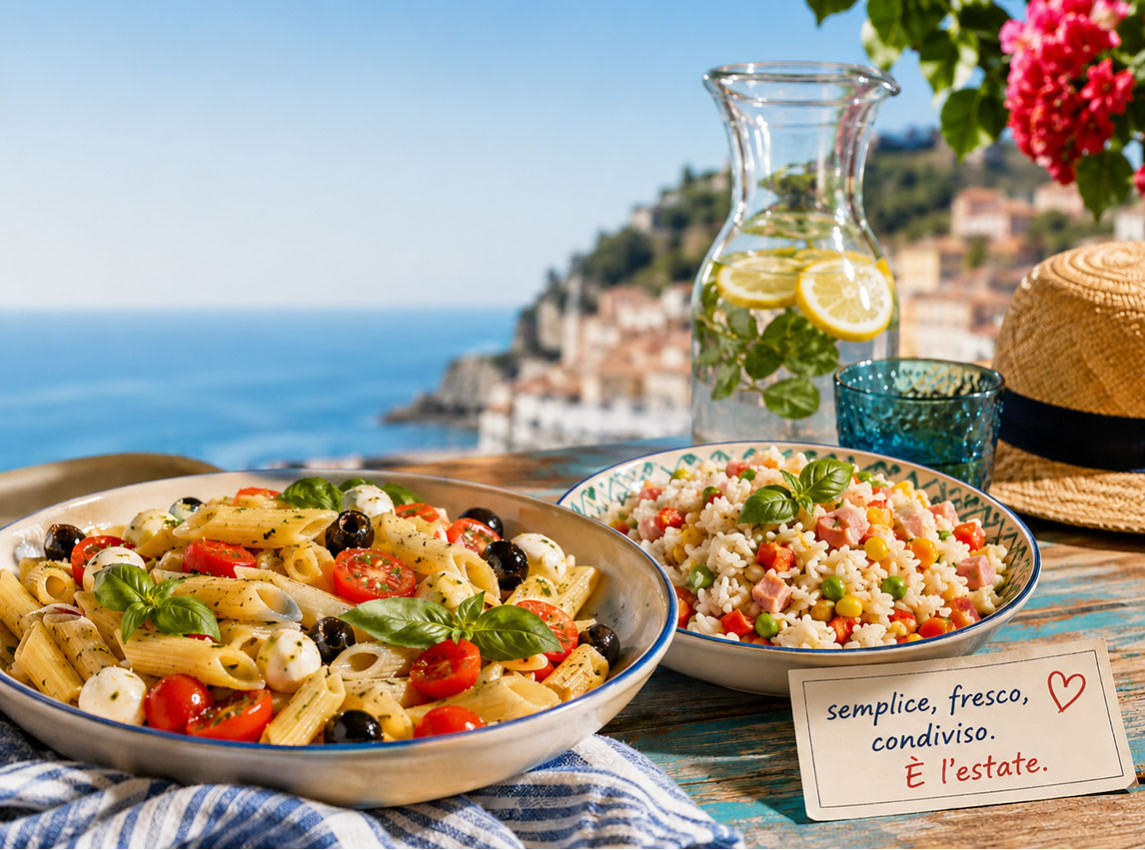
There's a precise moment when the Italian summer truly begins, and it isn't marked on the calendar.
It's when you open the fridge and find a large bowl covered in cling film, full of short pasta or colourful rice, ready for the beach, the day trip, the quick lunch on the terrace. Cold pasta, pasta fredda, and rice salad, insalata di riso, are the two dishes that, more than any other, tell the story of Italy when the heat arrives. And yet, precisely because they seem easy, they are among the most mistreated dishes in our cuisine, victims of a fundamental misunderstanding: that cold means improvised.
It isn't so, and you only need to ask anyone who has ever tasted a gluey cold pasta or a watered-down rice salad to understand that behind their apparent simplicity lies a small discipline made of timing, gestures, and choices. It's worth telling, because these two dishes are not summer fallbacks but full chapters of the Italian gastronomic tradition, with a longer and nobler history than one might think.
Two dishes, two mediterranean stories
The origins of cold pasta are lost in time, as happens with almost all popular dishes born out of necessity rather than recipe. What is certain is that it is a profoundly Mediterranean preparation, built around the symbolic ingredient of Italian cuisine. It's interesting to note how the dish has travelled and transformed elsewhere: in the United States, "pasta salad" is recognised as an American adaptation of what in Italy we call pasta fredda or insalata di pasta, a confirmation of how this formula has become an ambassador of our way of being at the table.
Rice salad, on the other hand, has a more documentable and in some ways more fascinating history. Although the idea of eating cold dressed cereals belongs to many cultures of the Mediterranean basin, from ancient Rome to Arab and Spanish traditions, the first codified recipe we can consider an ancestor of rice salad dates back to a cookery treatise by an anonymous author from Padua at the end of the fifteenth century. The dish as we know it today, however, took hold in the post-war period, especially in northern Italy, in the rice-growing regions such as Lombardy, Piedmont, Veneto, and Emilia, when rice became an affordable food within everyone's reach.
The dignity of the dish is testified by an authored recipe found in the August 1964 issue of La Cucina Italiana, signed by Italo Campiglia, then chef of the restaurant at the prestigious Hotel Villa Medici in Florence: rice, ripe tomatoes, anchovy fillets, artichokes preserved in oil, black olives, tuna, and parsley. An essential and elegant formula, light years away from the idea of rice salad as a mere fridge-emptier. It's worth remembering, among other things, that Italy is the largest rice producer in Europe, which makes this dish not only a summer one but deeply tied to our territory.
The rule of pasta: the veil of oil and the last minute
This is where everything is decided, and it's here that most people go wrong. The first mistake, the most common and the most serious, concerns the cooking. Pasta destined to be eaten cold should be drained al dente, one or two minutes before the time indicated on the packet, because it will continue to mature as it cools and would otherwise risk becoming mushy. Immediately after draining, it should be transferred to a large bowl and dressed at once with a generous drizzle of extra virgin olive oil, mixing well: the oil creates a protective veil that prevents the individual pieces from sticking together as the pasta cools.
There's one point on which schools of thought divide, and it's only fair to say so honestly. The traditional practice of rinsing pasta under cold water to stop the cooking is still very widespread, but professional kitchens advise against it: running water washes away the surface layer of starch, the very thing that binds the dressing, leaving the pasta flavourless and more prone to clumping. The chefs' advice is therefore to cool it with the veil of oil and at room temperature, avoiding even the fridge as a shortcut, because sudden cold strips away flavour. On the format there isn't much doubt: short shapes like penne, sedanini, mezze maniche, and ditalini prove better than long ones, because they hold the dressing better and don't form the dreaded "pastone" effect, that gluey mass.
The second fatal mistake is dressing too early. Ingredients rich in water, such as cherry tomatoes and mozzarella, release their water when in contact with salt and acidity, watering down the dish, while the cold of the fridge ruins the texture of dairy. The solution is the last-minute rule: prepare the base in advance, meaning pasta, oil, olives, tuna, perhaps pesto, and keep the delicate ingredients aside, cherry tomatoes, mozzarella, crisp vegetables, to be added only when serving. And if the damage is done and the pasta is already gluey, half a glass of water helps bring it back to life.
Rice salad and the value of real ingredients
For rice salad the golden rule starts with the choice of rice. Parboiled rice is the most suitable precisely because, being low in starch, it stays al dente and well separated even after hours, avoiding the glue effect that ruins so many home versions. Here too the rice should be drained at the right point and dressed with care, and here too the same logic applies of not overloading the dish: the secret of a good rice salad lies not in the number of ingredients but in their balance.
And it's precisely on the ingredients front that the difference is measured between an ordinary dish and a memorable one. Both cold pasta and rice salad live on what we put inside them, and no technical gesture can save a dish built with mediocre raw materials. A quality tuna preserved in oil, real olives rather than industrial pitted ones, capers in salt, sun-dried tomatoes, artisanal vegetable patés and creams, an expressive extra virgin olive oil: these are the details that transform a non-recipe into something worth bringing to the table. The right short pasta, perhaps bronze-cut, and an Italian parboiled rice do the rest.
It's in this logic that the summer pantry becomes central. Having artisanal pasta in good formats, quality Italian rice, properly made preserves in oil, selected tuna and legumes, condiments and oils that actually taste of something, means being able to improvise a summer dish without ever improvising its flavour. Because the beauty of these two dishes is exactly this: they are free, personal, different in every household, and yet they reward those who start from excellent foundations.
A free dish, but not a careless one
The truth is that cold pasta and rice salad closely resemble the Italians who prepare them: seemingly casual, in reality extremely attentive to detail. There's no single right recipe, everyone has their own, the family one, the grandmother's one, the one that recalls summers by the sea. But there is a right way to treat them, made of respect for timing, of handed-down gestures, and of a conscious choice of what goes inside.
Ultimately these are dishes that tell a precise idea of the Italian summer, the one in which even the simplest and quickest meal never gives up on quality. They are the lunch on the beach, the packed lunch at the office, the improvised buffet among friends, but they are also, on closer inspection, a small lesson in gastronomic culture: proof that in Italy even the cold, even the practical, even the fridge-emptier can become genuinely good, if treated with the respect they deserve.
More News
- The vendemmia: the ritual that bring Italy to a halt every september
- PPWR 2026: what changes for food producers and e-commerce
- The Italian Aperitivo: Native Sparkling Wines and Artisan Charcuterie
- Sunday lunch: the Italian architecture of slow time
- The Authentic Value of Italian Gastronomic Made in Italy
