


 Italiano

The Italian Aperitivo: Native Sparkling Wines and Artisan Charcuterie
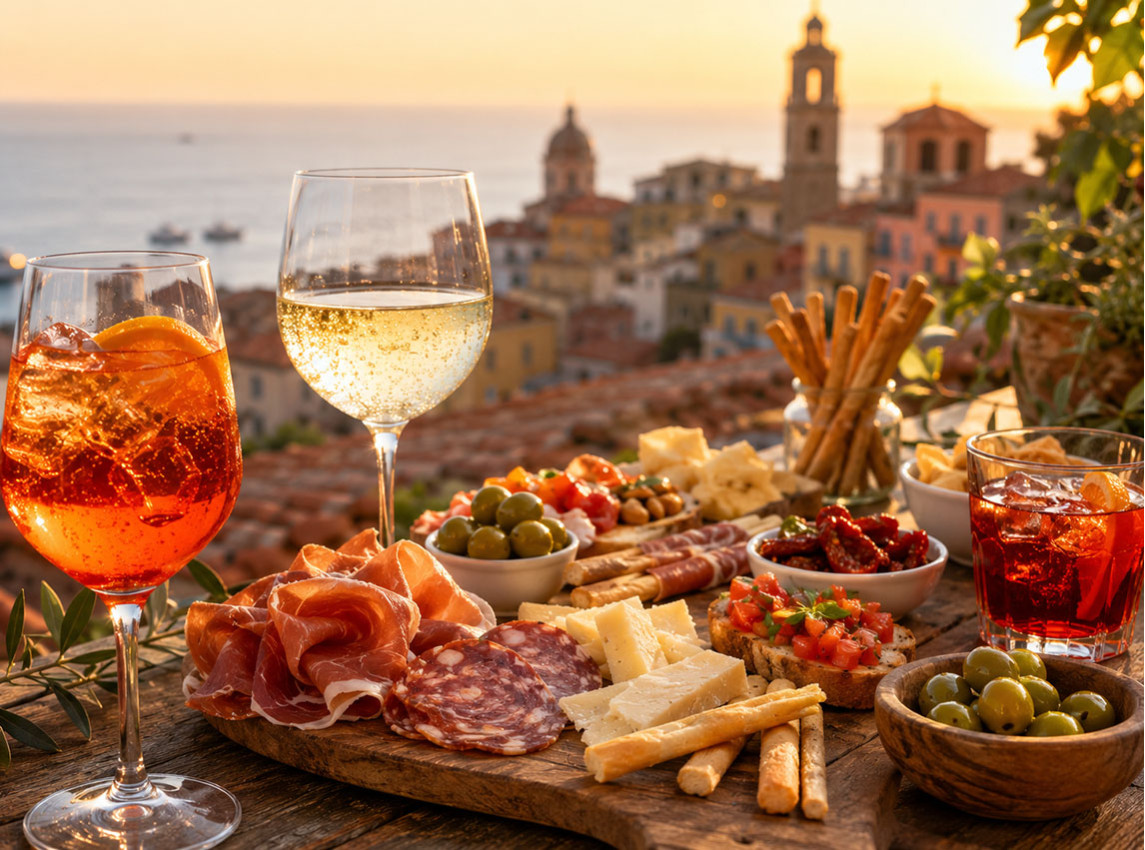
There is an hour of the day in Italy that belongs to everyone and no one. It is not yet evening, but the afternoon is already over. The sun is still high, but the light has shifted, the air has grown just a little softer, and somewhere nearby someone has already opened a bottle. This is the hour of the aperitivo, and anyone who has experienced it at least once in Italy knows there is no precise equivalent anywhere else in the world.
It is not simply about drinking. The Italian aperitivo is a daily rite of passage, a social appointment that marks the end of work and the beginning of free time, a moment of conversation and food governed by unspoken rules that everyone knows but no one has ever written down. And like every rite worth observing, it deserves ingredients that are equal to the occasion.
A brief but intense history
The word comes from the Latin aperire, to open: the aperitivo was born as a preparation for the stomach before a meal, an almost medicinal function that found its most refined form in eighteenth-century Turin. It was there, in 1786, that Antonio Benedetto Carpano invented vermouth, a herb-infused wine that quickly became a symbol of Piedmontese table culture. From Turin the ritual spread toward Milan with Campari, toward the Veneto with the Spritz, and southward with local variations built around citrus and regional spirits.
The charcuterie board as we know it today, however, is a more recent achievement. It is the natural evolution of a culture that cannot sit down without bringing something good to the table, and that over time transformed what was once a simple excuse to have a drink into a full gastronomic occasion. The Italian board, when done well, is a portrait of a territory: it speaks of where you are, of who made what is in front of you, of a supply chain that begins in a dairy or a curing cellar and ends on the wood before you.
The right bubbles: native grape varieties against homogenisation
Italy produces over one hundred native grape varieties, a reserve of wine biodiversity that has no equal in the world. Yet for years the story of Italian sparkling wine has narrowed around a handful of names, flattening an extraordinary variety beneath the umbrella of a few denominations that became synonymous with the category itself. The result is that many consumers do not know there are Italian sparkling wines made from grapes that grow nowhere else on earth, with aromatic profiles that the big names could not replicate even if they tried.
Pecorino from Abruzzo, for example, has nothing to do with the cheese of the same name: it is a native white grape variety from the central Apennines, probably one of the oldest on the peninsula, and it owes its name to the fact that sheep used to eat it during the transhumance migrations before farmers learned to keep them away. As a sparkling wine it produces fine bubbles, a mineral and floral fragrance, a freshness that pairs perfectly with the rich fat of aged cured meats. Passerina, also from Abruzzo, is more delicate, with notes of white fruit and field flowers, less structure but more elegance: ideal alongside a semi-aged cheese or a quality mortadella. And then there is Malvasia Puntinata, a native grape from the Castelli Romani hills south of Rome, aromatic and seductive, capable of balancing the assertive flavours of a well-built board without overwhelming any of its details.
These are grape varieties that tell the story of a precise place, not a commercial category. Choosing to drink them means choosing to understand Italian wine more deeply, and that is exactly the kind of choice an aperitivo deserves.
Aged cheese and its many expressions
Among Italian cheeses, pecorino is the one that lends itself most naturally to creative ageing, the kind that turns an already excellent product into something unique through the environment in which it matures. Ageing in a pit, for example, is a medieval technique that involves storing the cheese in hollows carved into tuff or sandstone, sealed for months in an anaerobic microenvironment that radically transforms the paste: the pecorino emerges sharper, with an intense aromatic complexity and a crumbly texture that breaks apart at the cut. It is a cheese that communicates eight centuries of peasant knowledge in a single slice.
Ageing in fig leaves is something more delicate and surprising: the leaves transfer their vegetal tannins and an almost sweet, wild fragrance to the cheese, creating a contrast between the saltiness of the pecorino and that botanical note which, alongside a glass of dry sparkling wine, works in an extraordinary way. The version aged in Merlot grape skins brings the wine into the cheese itself: the rind takes on a violet hue and the paste absorbs the fruity notes of the fermented grape skins, an arrangement that inverts the traditional cheese-and-wine logic by placing both inside the same product. Finally, the cheese with white and black truffle, semi-aged, needs little introduction: it is one of those products that explains at first taste why Italian cheesemaking is beyond comparison.
Italian cured meats: an inexhaustible heritage
If there is one sector of Italian gastronomy that has demonstrated an inexhaustible creative capacity over time, it is the art of curing meat. Every region has its own salumi, every salume has its own story, and the best artisan productions continue to surprise even those who believe they already know everything on the subject.
Alongside the classics that never disappoint, such as aged prosciutto crudo, coppa or culatello, there are interpretations that deserve a place of their own on any self-respecting board. Mortadella, for example, is one of the great misunderstood products of Italian charcuterie: long considered a popular and slightly humble food, it conceals in reality a complex production technique and a very long tradition. In its most inventive artisan forms it takes shapes that genuinely surprise: the version made from Suino Nero dei Nebrodi, an endangered native Sicilian breed, with a dark and flavourful meat that resembles no industrial mortadella; the one with bitter orange and toasted almonds, which balances the fat of the meat with a fragrant acidity; the one with wild fennel, almost Mediterranean in its aromatic profile; the one with truffle, which turns an informal antipasto into something considerably more refined.
Artisan salami made from sheep's meat, a category that rarely receives the attention it deserves, bring a different kind of saltiness from that of pork, more intense and wilder, which paired with an aged pecorino and a glass of dry sparkling wine forms a combination of absolute territorial coherence.
The board as a cultural act
The aperitivo, when you think about it carefully, is the only Italian meal without a fixed recipe. There is no rigid grammar to a charcuterie board the way there is for pasta alla carbonara or risotto alla milanese: there is freedom, improvisation, the possibility of building something personal starting from excellent ingredients.
But it is precisely in this freedom that the risk lies. A board built with mediocre products does not improve with good presentation, and no selection of industrial snacks can compete with what a pit-aged pecorino can do when paired with a native-variety sparkling wine and a cured meat that comes from a farm where people know the names of their animals.
The real Italian aperitivo is not a social media moment to be photographed. It is a time of conviviality that deserves the same respect Italians give to Sunday lunch or Christmas dinner. It begins with the choice of what to put on the board, and that choice, like almost everything in the kitchen, says a great deal about who we are.
More News
- World Pasta Day 2026: Italy's pasta in numbers
- Fettuccine Alfredo: the true story of the Roman dish the world believes is American
- The vendemmia: the ritual that bring Italy to a halt every september
- PPWR 2026: what changes for food producers and e-commerce
- Cold pasta and rice salad: the unwritten etiquette of the Italian summer
