


 Italiano

Almonds, honey and figs: the ancient sweets of the Italian Christmas
When we think of Christmas sweets in Italy, our minds go straight to the great leavened cakes.
Yet in the Italian countryside the holidays also had another flavour, made of few ingredients and a great deal of patience: nuts, honey, seeds. These were sweets born to preserve what summer had given and to bring it to the table in the cold months, when the pantry became the true treasure of the home.
The farming calendar tells the story better than any recipe book. In Sicily sesame is harvested between the end of August and September, while in the Vallesina, the valley in the Marche region near Ancona, figs are picked and dried from August to September. These late-summer harvests, worked with honey and almonds, become the sweets of winter. This is the journey we invite you on, from the province of Ragusa to the hills of Ancona.
Cobaita, the sesame that came with the Arabs
Sesame is an ancient crop for Sicily, introduced to the island during the period of Arab rule. Around Ispica, in the south-east of the island, farmers selected a local variety about two centuries ago, with small, amber-coloured seeds and an intense flavour. Harvesting is still done by hand: the plants are gathered before the capsules open on their own, left to dry in the sun for a few days and beaten on a cloth, several times, before the seeds are cleaned with special sieves called crivelli.
It is a story that nearly came to an end. Until fifty years ago, around 450 hectares in Sicily were planted with sesame, 400 of them in the province of Ragusa. Then the hard work of the harvest and competition from cheap imported seed led most of the fields to be abandoned, until only a few farmers kept replanting their own seed. Today Ispica sesame is a Slow Food Presidium, and the Slow Food Foundation describes the cobaita made from it as "the nougat of the holidays".
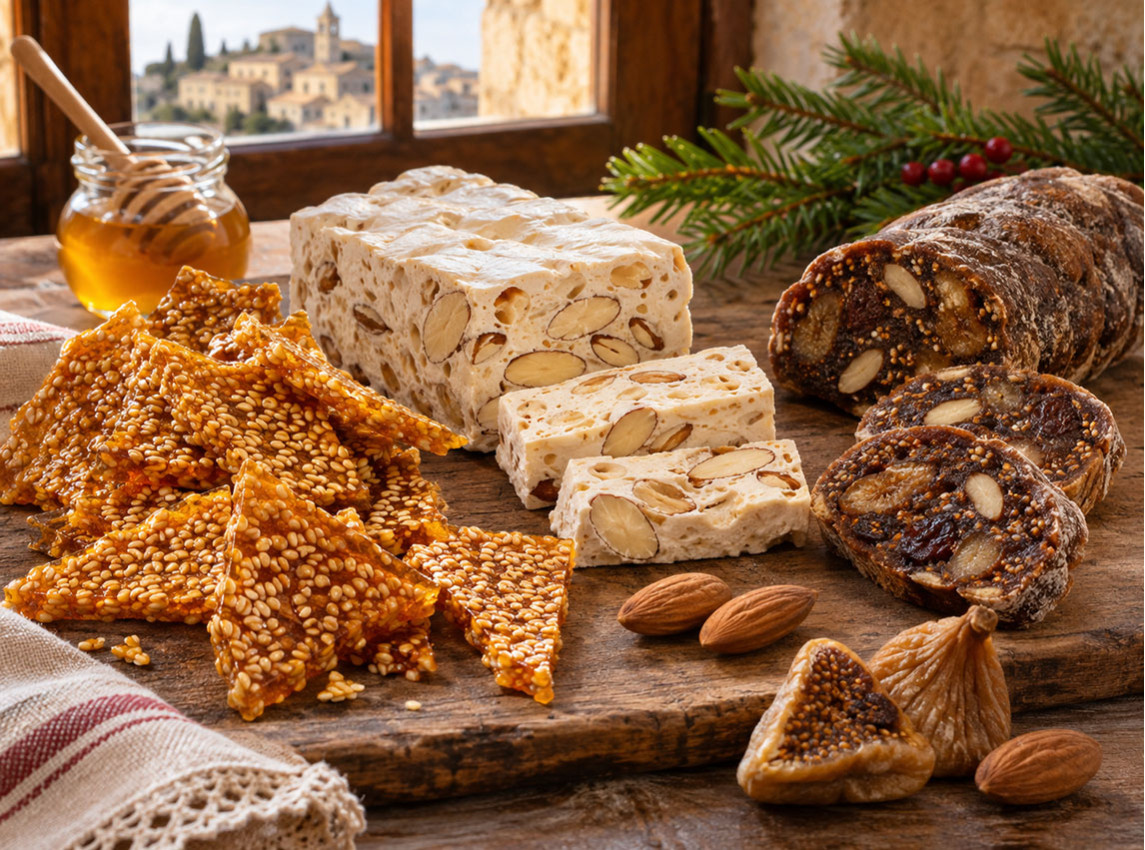
Cobaita, which in eastern Sicily is also called giuggiulena, is a brittle of sesame, honey and sugar, to which almonds and citrus peel may be added. The Sicilian Region lists it among its Prodotti Agroalimentari Tradizionali, the official register of traditional Italian food products, under the name "giuggiolena o cubbiata", and in the Ragusa area it is never missing from the Christmas table. The Cobaita made by Antica Dolceria Rizza in Modica follows this tradition: sesame makes up half of the mixture, together with sugar, honey, almonds, hazelnuts, pistachios and orange peel.
Almond torrone and honey from the Iblei mountains
Alongside cobaita, almond torrone is the other great brittle of the Sicilian holidays. Here too the tradition is officially recognised: the Prodotti Agroalimentari Tradizionali of Sicily include the Torrone di Caltanissetta, called turruni in Sicilian dialect, the Mandorla di Avola almond and Miele Ibleo, the honey of the Iblei mountains, which are exactly the ingredients and skills this sweet relies on.
Rizza's Torrone Abbrustolito di Mandorle, a toasted almond torrone, is all about the raw material. Almonds make up 71% of the mixture, bound with sugar and zagara honey from the Iblei, zagara being the Sicilian word for orange blossom, and scented with cinnamon and natural orange flavouring. It was traditionally a Christmas sweet; today it can be found all year round, but in December it returns to its natural place, at the end of a meal or next to an espresso.
For those who love fuller flavours there is the Torrone di Pistacchio, built on the same proportion: 71% pistachio, with zagara honey, cinnamon and natural orange flavouring. Two versions of the same ancient gesture, binding the best of the harvest with honey.
Lonzino di fico, the farmhouse pantry of the Marche
We now travel up the peninsula to the Vallesina, in the province of Ancona, in the area of the Castelli di Jesi. Here figs ripened in abundance just before the grape harvest, and farmers worked hard to preserve them in a thousand ways. This is how the "salamotti dolci di fichi", sweet fig salamis, were born. They lasted the whole winter until spring: children were given them as a snack, and they were served at the end of holiday meals.
The recipe is disarmingly simple. Dried figs of the Dottato or Brogiotto varieties, almonds, pieces of walnut and anise seeds, sometimes kneaded with a little sapa, grape must cooked down for a long time, or with mistrà, a liqueur made from anise. The mixture is wrapped in fig leaves and tied with string or wool, becoming one of the "lonze" or "lonzini" that give the sweet its name. Cut into slices that are not too thin, it shows a fine paste of figs with almonds and walnuts, and on the nose it offers ripe fruit with an enveloping note of anise.
Today lonzino di fico is a Slow Food Presidium supported by the Marche Region, bringing together the last producers of this tradition. In collaboration with Assam, the agri-food agency of the Marche Region, more than 200 fig trees have been planted. La Bona Usanza, a farming cooperative in Serra de' Conti devoted to recovering traditional products at risk of disappearing, counts lonzino among its two Slow Food Presidia. Its Lonzino di Fico is made with sun-dried figs, walnuts, almonds, anise seeds and mistrà, wrapped in a fig leaf, tied by hand with woollen thread and free of preservatives.
At the end of the meal, the right glass
Sweets this concentrated call for a wine that can accompany them without overwhelming them. For lonzino, the Slow Food Presidium is precise: a cheese that is not soft, of medium age, and a glass of passito, the Italian dessert wine made from dried grapes. Served with sapa, Slow Food adds, its sweetness stands out even more, with notes of caramel.
From the hills of Monte Porzio Catone, in the Castelli Romani near Rome, comes Passione by Casal Pilozzo, a passito made from Malvasia del Lazio grapes. The grapes grow in a single vineyard at 350 metres, facing north-east, and are left to dry on the vine for about 45 to 50 days. After fermentation the wine matures in small steel tanks and then, already bottled, for nine months in tuff caves at 15 degrees. Its colour is gold, turning amber with age, and on the nose it brings honey, hazelnut and dried fruit: a true vino da meditazione, a wine for slow sipping, which finds a natural companion in lonzino and is well worth trying with a piece of torrone too.
A Christmas made from the pantry
Cobaita, torrone and lonzino tell the story of an Italy that brought its own harvest to the Christmas table, transformed by hand and by time. They are sweets that need no decoration, because their richness lies entirely in their ingredients and in the memory of the places that have looked after them.
And for those who do not want to give up a leavened cake without leaving Sicily, Modica also offers Rizza's Panettone Artigianale con PepiteModica, made with Cioccolato di Modica IGP, the town's protected chocolate. On 360ItalyMarket all these products are packed and shipped directly by their producers, from the pastry shop to your holiday table.
More News
- World Pasta Day 2026: Italy's pasta in numbers
- Fettuccine Alfredo: the true story of the Roman dish the world believes is American
- The vendemmia: the ritual that bring Italy to a halt every september
- PPWR 2026: what changes for food producers and e-commerce
- The Italian Aperitivo: Native Sparkling Wines and Artisan Charcuterie
