


 Italiano


Fettuccine alla Alfredo: the true story of the Roman dish the world believes is American
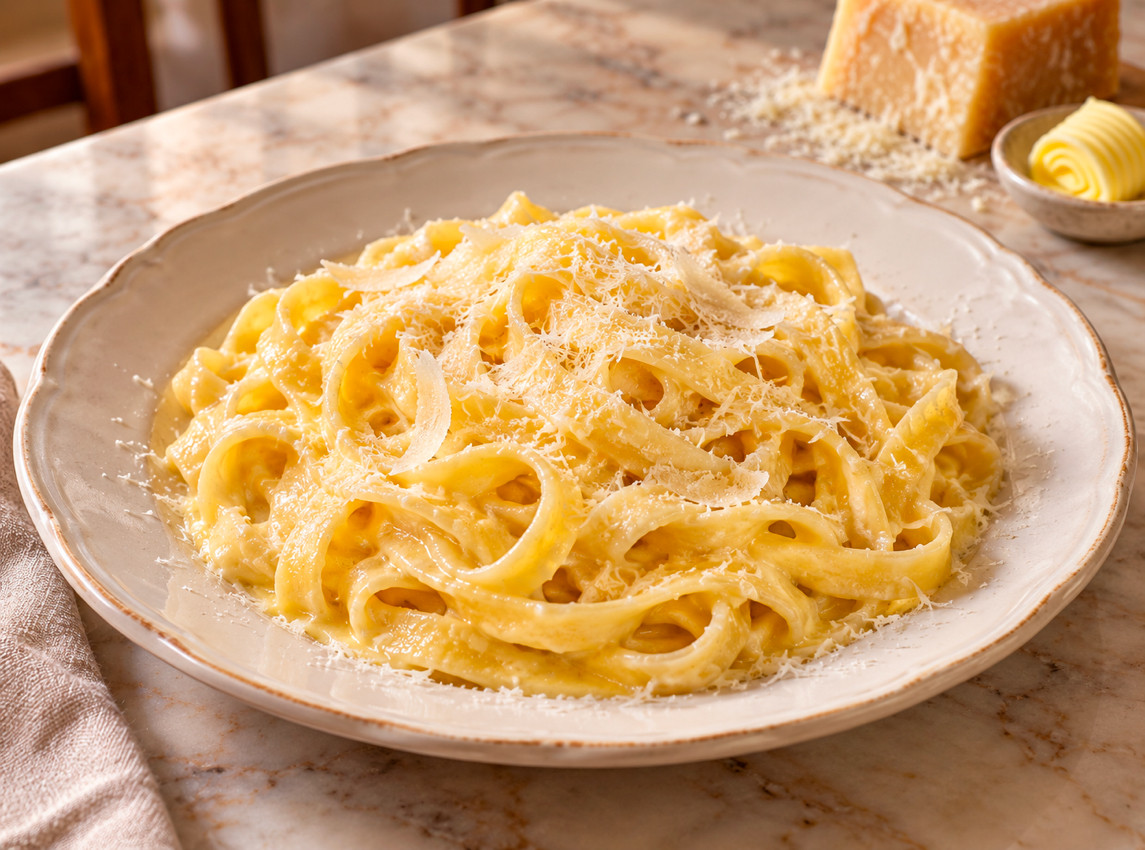
Ask Google which Italian recipe the world searches for most, and the answer surprises almost every Italian.
It is not carbonara, not ragù alla bolognese, not tiramisù. According to an analysis by Affidabile.org based on Google Trends data, reported by WineNews in April 2025, the top spot belongs to Fettuccine Alfredo, searched for above all from Malta, the United States, Australia and Canada.
The paradox is that in Italy the name means almost nothing. Outside Rome nobody orders "Alfredo", and anyone who meets the dish in an American restaurant, buried under cream, chicken and broccoli, assumes it was invented overseas. Yet Alfredo was a real man, he was Roman, and his dish is as Italian as food can be: fettuccine, butter and Parmigiano. Nothing else.
A dish as old as Rome
Pasta, butter and cheese belonged together long before Alfredo. Around 1460 Maestro Martino da Como, a cook working in Rome, described in his "Libro de arte coquinaria" the "maccaroni romaneschi", boiled in rich broth or water and dressed with fresh butter, good cheese and sweet spices. It is the documented ancestor of a gesture that has never stopped in Italian homes.
This is why an Italian who hears "Fettuccine Alfredo" simply thinks of pasta al burro, buttered pasta, the dish of childhood, of days spent recovering from an illness, of evenings when the fridge is empty. Alfredo's achievement was not inventing a pairing, it was refining it until it became a performance.
1908, a trattoria in Piazza Rosa
The story, as the family tells it, begins in 1908 (some sources say 1907) in the trattoria that Alfredo's mother Angelina ran in Piazza Rosa, a small square in the centre of Rome that disappeared a few years later to make room for the Galleria Colonna, today Galleria Alberto Sordi. Alfredo Di Lelio worked there, and his wife Ines, after the birth of their first son Armando, was weak and had lost her appetite.
So Alfredo made her a plate of fettuccine with his own hands, dressed with plenty of butter and Parmigiano. The family restaurant's website even records the line he served it with: "If you don't like it, I'll eat it myself!" Ines liked it so much that she suggested putting it on the menu. In fairness, this is a family account and not an archive document, but nobody has ever disproved it, and it explains the nature of the dish well: food made to care for someone, before it was food made to impress.
In 1914 Alfredo opened a place of his own in Via della Scrofa. The fettuccine became the house speciality, and he performed the mantecatura himself, the tossing of pasta with butter and cheese until creamy, in front of his guests, with a theatrical flair that writers of the time compared to an orchestra conductor.
Hollywood in Via della Scrofa
The turning point came from America. In 1920 Douglas Fairbanks and Mary Pickford, the two greatest stars of silent cinema, were in Rome on their honeymoon and ate at Alfredo's. In 1927, as food historian Luca Cesari reconstructs in Gambero Rosso, the couple gave him a solid gold fork and spoon engraved "To Alfredo the King of the noodles". From then on the golden cutlery became part of the ritual.
Word travelled fast among American visitors. As early as 1922 Sinclair Lewis, in his novel "Babbitt", has a character mention "a little trattoria on the Via della Scrofa where you get the best fettuccine in the world". Guidebook author Clara Laughlin wrote: "Most travellers would blush to admit they had been in Rome and had not eaten Alfredo's fettuccine al burro".
In 1933 the American restaurateur and writer George Rector described the scene in words that became famous: "As a violinist plays inspiring music, Alfredo performs the sacred ceremony with a fork and spoon of solid gold. Alfredo does not cook noodles. He does not make noodles. He achieves them."
Two restaurants, one name
In 1943, in the middle of the war, with flour, eggs and butter ever harder to find, Alfredo sold the restaurant in Via della Scrofa. In 1950 he reopened with his son Armando in Piazza Augusto Imperatore, under the sign "Il Vero Alfredo", the real Alfredo. He died in 1959.
Since then two Roman restaurants have claimed the legacy, a few hundred metres apart: Alfredo alla Scrofa, in the historic premises, and Il Vero Alfredo, still run by the Di Lelio family with his granddaughter Ines. Both have walls covered in photographs of celebrities, and both serve the fettuccine tossed at the table.
How America changed the recipe
While the dish stayed the same in Rome, in the United States it took a different road. The name "Alfredo" detached itself from the man and became a sauce. In 1966 the Pennsylvania Dutch Noodle Company marketed fettuccine with an "Alfredo" recipe that, alongside butter and Parmesan, included Swiss cheese and cream. It was the beginning of the version the world knows today: a thick white sauce, often sold in a jar, with chicken, shrimp or broccoli added.
In Italy, meanwhile, the dish carried on under other names. Cookbooks call it "tagliatelle al burro" in 1948, and "fettuccine al triplo burro", triple butter fettuccine, in Luigi Carnacina's 1961 work. Nobody felt the need to mention Alfredo, because for an Italian this is not a signature recipe, it is simply home.
That explains the paradox we started with: the world googles a Roman dish believing it to be American, and Italians have always eaten it without knowing that abroad it has a name of its own. Every 7 February the United States even celebrates Fettuccine Alfredo Day.
The authentic recipe: three ingredients and one gesture
The recipe attributed to Alfredo Di Lelio calls only for egg fettuccine, butter and young Parmigiano. No cream, no garlic, no chicken. The creaminess that Americans look for in cream actually comes from the mantecatura: the pasta, drained al dente and still wet with its cooking water, is tossed at length with the butter and cheese until the three bind into a glossy cream.
With three ingredients there is nowhere to hide, and everything depends on their quality. You need a pasta that holds its bite and grips the dressing, like the fettuccine and egg tagliatelle from the artisan pasta makers we select at 360ItalyMarket. You need good butter and Parmigiano grated at the last moment.
The rest is the gesture, the same one Alfredo repeated in front of Fairbanks and Pickford. Try it once and you will understand why, more than a century later, the world is still searching for it.
More News
- The vendemmia: the ritual that bring Italy to a halt every september
- PPWR 2026: what changes for food producers and e-commerce
- The Italian Aperitivo: Native Sparkling Wines and Artisan Charcuterie
- Cold pasta and rice salad: the unwritten etiquette of the Italian summer
- Sunday lunch: the Italian architecture of slow time
